New KCA Mission Statement
At their December 6, 2025, meeting, the KCA Board of Directors officially approved our new mission statement:
“Empowering chiropractors with community, advocacy, resources, and education.”
This mission is a key component of a larger strategic plan update that the Board also approved. We will be sharing more details about the full plan with the association soon.
Click here for more information about the updated KCA Strategic Plan.

Year-End Compliance Checkup: Don’t Let Licensing or CE Become an Emergency
As the year draws to a close, it’s easy to get wrapped up in holiday schedules, vacations, and planning for the new year. But one area that deserves every chiropractic practice’s attention right now is compliance, particularly Board requirements and continuing education (CE). A few minutes of intentional review in December can prevent last-minute stress (or worse) during renewal season.
CE Hours: Verify Now, Don’t Scramble Later
The Kansas Board of Healing Arts requires every chiropractor to maintain accurate documentation of CE hours to ensure hours are complete and properly recorded.
Before December ends, take time to:
- Confirm the total number of CE hours completed this year
- Make sure you have certificates saved for every course — digital or printed
- Verify that your CE hours meet the required categories, including Category III
- File certificates in a single, easy-to-find location in case of an audit
If you’re missing a few hours or still need Cat III, KCA can help.
We’ve added several new CE courses on our website, including a brand-new Category III hour, which has been one of the most commonly requested offerings this year. Providers can complete these hours on their own schedule and download their certificate immediately upon completion on the KCA Website.

Office Holiday Hours
The Kansas Chiropractic Association office will be closed Monday, December 22, 2025, through Friday, January 2, 2025, for the Christmas and New Year’s Holidays. We will reopen for regular business hours on Monday, January 5, 2025.
I will be available to return emails and phone calls as needed during this time.
Warmest wishes for a safe and meaningful Christmas holiday.
Dr. Travis Oller
Chiropractic Education Protected Under New Department of Education Rules — A Major Win for the Profession
The U.S. Department of Education has finalized a major restructuring of how advanced degrees are classified for federal student-loan purposes. Going forward, the federal government will officially distinguish between “professional degrees” and general graduate degrees, and that distinction will determine how much a student can borrow and which types of loans they’re eligible for.
This change may sound procedural, but it carries real implications — especially for healthcare education.Under the new definition, several well-known healthcare degrees, including nursing, physical therapy, and physician assistant programs, were not classified as professional degrees. Students in those programs will soon face lower annual and lifetime borrowing limits, and may lose access to certain federal loan programs that have historically made graduate healthcare education financially possible.
However, there is significant good news for chiropractic:
Doctor of Chiropractic programs were explicitly classified as professional degrees.This means chiropractic students will retain eligibility for the higher “professional-level” borrowing caps, preserving access to the federal financial-aid resources necessary to complete a DC education. Without this designation, many future chiropractors could have been pushed into costly private financing or priced out of the degree entirely.
This outcome is not an accident or luck.
Chiropractic’s inclusion as a federally recognized professional degree is the direct result of long-term advocacy and lobbying efforts by chiropractic associations at both the national and state levels. When federal policies affecting higher education and healthcare were being drafted, the chiropractic profession was present, organized, and persistent in making sure our degree, our academic rigor, and our professional status were not overlooked.
A takeaway for every chiropractor
Decisions like this shape the future of our profession — and they are made years before most people ever hear about them. Advocacy doesn’t happen only when there is a crisis. It happens quietly and consistently in legislative offices, regulatory meetings, and agency listening sessions where the profession must have a voice.That’s why every chiropractor should be a member of their state association.
Membership ensures:
- The profession has a seat at the table when major decisions are made
- Policies affecting education, reimbursement, and scope are not made without chiropractic input
- The next generation of chiropractors has access to the opportunities we have today
This victory for chiropractic education is proof that organized advocacy works. The work we do today protects the profession for tomorrow.
If you are already a member of the KCA, thank you.
If you’re not yet a member, we invite you to join us.
The future of chiropractic is shaped by those who show up.
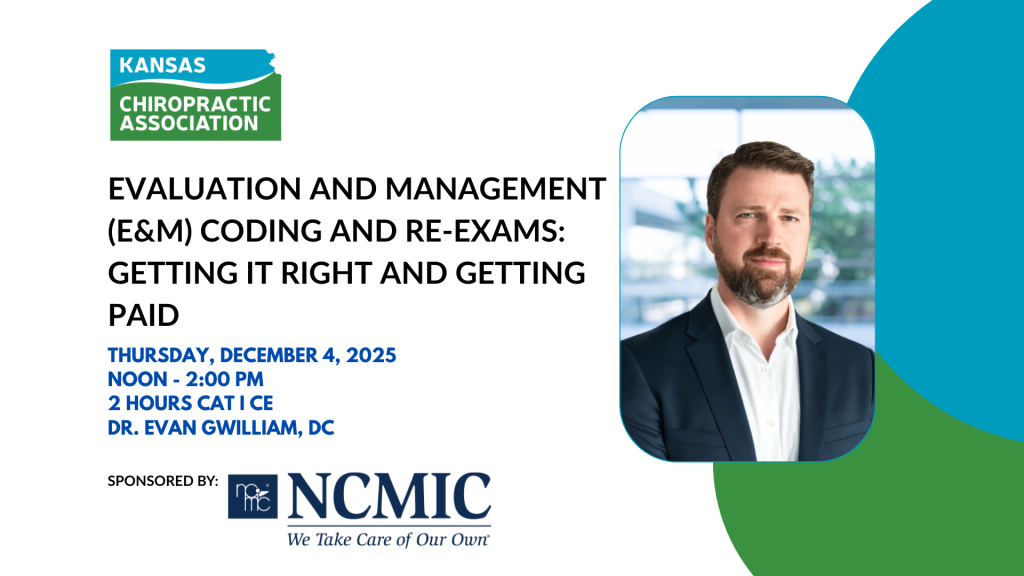
Evaluation and Management (E/M) Coding and Re-Exams: Getting It Right and Getting It Paid
Thursday, December 4, 2025 – Noon to 2:00 PM (available on demand after air date)
Hour 1 — Making Sense of E/M Coding for Chiropractors
Description: Chiropractors must comply with the same E/M documentation rules as other healthcare providers—but most guidelines were never written with chiropractic in mind. In this first hour, Dr. Gwilliam simplifies the 2021–2024 E/M changes, showing which rules actually apply in a chiropractic setting and how to use them to accurately select and document the proper level of service. Attendees will gain practical examples and note verbiage that make E/M compliance less confusing and more consistent.
Learning Outcomes
By the end of this hour, attendees will be able to:
- Interpret the 2021–2024 E/M coding guidelines as they apply to chiropractic encounters.
- Differentiate between MDM-based and time-based code selection, and identify which is most defensible in chiropractic practice.
- Construct compliant documentation that supports the selected E/M level and withstands payer review
Hour 2 — Re-Exam Reality Check: When E/M and CMT Can Coexist
Description: In this second hour, Dr. Gwilliam explores one of chiropractic’s most common billing and compliance headaches: performing and documenting a re-exam on the same day as a CMT. Learn how to identify when a re-evaluation is clinically justified, how to document it as a “significant, separately identifiable” service, and how to apply the correct modifiers and diagnosis pointers to minimize denials while maintaining ethical compliance.
- Learning Outcomes
- By the end of this hour, attendees will be able to:
- Identify clinical situations that justify a separately reportable E/M service in conjunction with CMT.
- Apply payer and coding guidance—including the 25 modifier and NCCI edits—to create compliant re-exam documentation.
- Distinguish between routine care and medically necessary re-evaluations to ensure accurate, defensible records.
Recent Comments